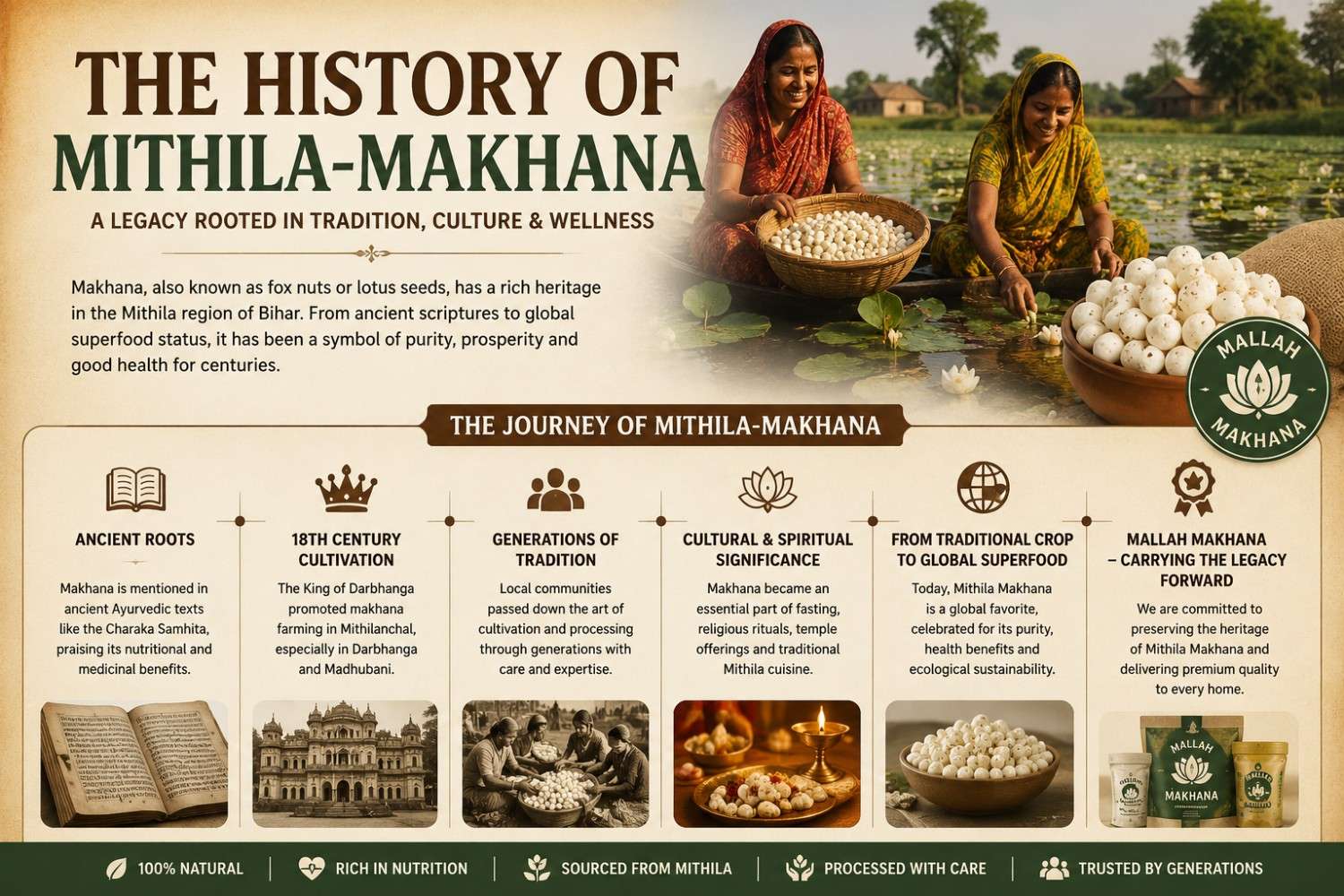
Long before Makhana became a popular healthy snack in supermarkets and online stores, it was growing naturally in the freshwater wetlands of Asia. For centuries, these small white seeds have been harvested by skilled farming communities using traditional techniques passed down through generations. Today, makhana is recognised as a nutritious superfood across the world, but its story began in ponds, lakes, and marshes where nature and human knowledge worked together.
The history of Makhana is much more than the history of a food crop. It reflects India's rich agricultural heritage, sustainable wetland farming, traditional food culture, and the dedication of farming communities, especially those in Bihar. who have preserved this unique crop for generations.
Origin and Early History of Makhana
When discussing the history of Makhana cultivation, Bihar occupies a central place. Today, the state is recognised as India's leading producer of makhana, and its reputation has been built over generations of experience rather than large-scale industrial farming.
The northern districts of Bihar, particularly the Mithila region, offer ideal conditions for cultivating Euryale ferox. Extensive wetlands, fertile alluvial soil, abundant rainfall, and a warm climate create a natural environment where the crop flourishes. Districts such as Darbhanga, Madhubani, Purnia, Katihar, Araria, and Supaul have become well known for their Makhana production.
However, Bihar's success is not due to geography alone. Local farming communities developed specialised expertise in pond management, underwater harvesting, seed drying, roasting, and popping. These traditional techniques have been refined over centuries and continue to influence modern cultivation.
History of Makhana in Bihar
When discussing the history of Makhana cultivation, Bihar occupies a central place. Today, Bihar produces the majority of India's commercial Makhana, with the Mithila region serving as the heart of cultivation.
Districts including:
-
Darbhanga
-
Madhubani
-
Katihar
-
Purnia
-
Araria
-
Supaul
provide ideal conditions because of their extensive wetlands, fertile alluvial soil, warm climate, and abundant rainfall.
However, Bihar's success is not based on geography alone.
Local farming communities have developed specialised knowledge of:
-
Pond management
-
Underwater harvesting
-
Seed drying
-
Traditional roasting
-
Hand popping
These techniques have been refined over generations and continue to support the state's leadership in Makhana production.
Historical Timeline of Makhana
|
Period |
Key Development |
|
Ancient India |
Makhana becomes part of traditional diets and Ayurvedic practices. |
|
Medieval Period |
Cultivation expands across the wetlands of the Mithila region. |
|
19th–20th Century |
Commercial production and regional trade gradually increase. |
|
Modern Era |
Scientific research, improved farming methods, and exports drive global popularity. |
Makhana also plays a vital role in Bihar's rural economy. Thousands of farmers, labourers, processors, traders, and small businesses depend on its cultivation and processing for their livelihoods. As demand for healthy snacks has increased in India and abroad, makhana has become an important agricultural commodity that supports employment and rural development.
Evolution of Makhana Cultivation
The evolution of Makhana cultivation demonstrates how traditional farming knowledge has adapted to modern agricultural practices.
Traditional Cultivation
Historically, Makhana was grown in natural ponds and wetlands.
Farmers manually:
-
Collected fruits from underwater.
-
Separated the seeds.
-
Dried them under sunlight.
-
Roasted the seeds.
-
Hand-popped each seed using traditional techniques.
This process required years of experience and physical skill.
Modern Cultivation
Today, scientific research and improved farming techniques have helped increase productivity.
Modern cultivation includes the following:
-
Better pond management.
-
Improved seed selection.
-
Scientific farming practices.
-
Enhanced processing methods.
-
Quality control.
-
Modern packaging for domestic and international markets.
Despite these improvements, much of the harvesting and popping process still relies on skilled manual labour.
Why Bihar Leads Makhana Production
|
Factor |
Bihar's Strength |
|
Natural wetlands |
Large network of ponds, lakes, and marshes |
|
Climate |
Warm, humid conditions ideal for aquatic crops |
|
Traditional knowledge |
Centuries of inherited farming expertise |
|
Skilled workforce |
Experienced farmers and processors |
|
Market ecosystem |
Strong cultivation, processing, and trade network |
Why the History of Makhana Matters
The story of Makhana is about much more than food. It reflects the relationship between people and nature, the preservation of traditional farming knowledge, and the importance of wetlands in supporting sustainable agriculture. Every popped seed represents generations of experience, patience, and craftsmanship developed by farming communities.
Learning about the history of Fox Nuts also helps consumers appreciate the effort behind every harvest. From underwater seed collection to careful roasting and popping, the production process remains one of the most unique forms of agriculture practised in India.
As global demand continues to grow, protecting traditional cultivation methods while embracing modern innovations will be essential for ensuring the long-term sustainability of the Makhana industry.
Key Historical Facts About Makhana
-
Makhana comes from the aquatic plant Euryale ferox.
-
It has been cultivated in Asian wetlands for centuries.
-
Bihar is India's largest producer of commercial Makhana.
-
Harvesting Makhana requires skilled underwater collection of fruits.
-
Every popped seed undergoes roasting before expansion.
-
Traditional knowledge continues to play an important role in cultivation.
-
Makhana remains an important crop for thousands of farming families.
-
Growing global demand has increased its value as a healthy snack.
Frequently Asked Questions
What is the history of Makhana?
Makhana has been cultivated in Asia for centuries from the aquatic plant Euryale ferox. In India, it became an important food crop known for its nutritional value, cultural significance, and traditional farming methods.
Where did Makhana originate?
Makhana originated in the freshwater wetlands of Asia. It naturally grows in countries including India, Nepal, China, Bangladesh, Japan, and Korea, with Bihar becoming India's primary cultivation centre.
Why is Bihar famous for Makhana?
Bihar's abundant wetlands, favourable climate, fertile soil, and generations of skilled farmers have made it the largest producer of makhana in India.
Is Makhana the same as lotus seeds?
No. Makhana comes from Euryale ferox, while lotus seeds are harvested from the lotus plant (Nelumbo nucifera). Although both are aquatic seeds, they differ in botanical origin, appearance, and processing.