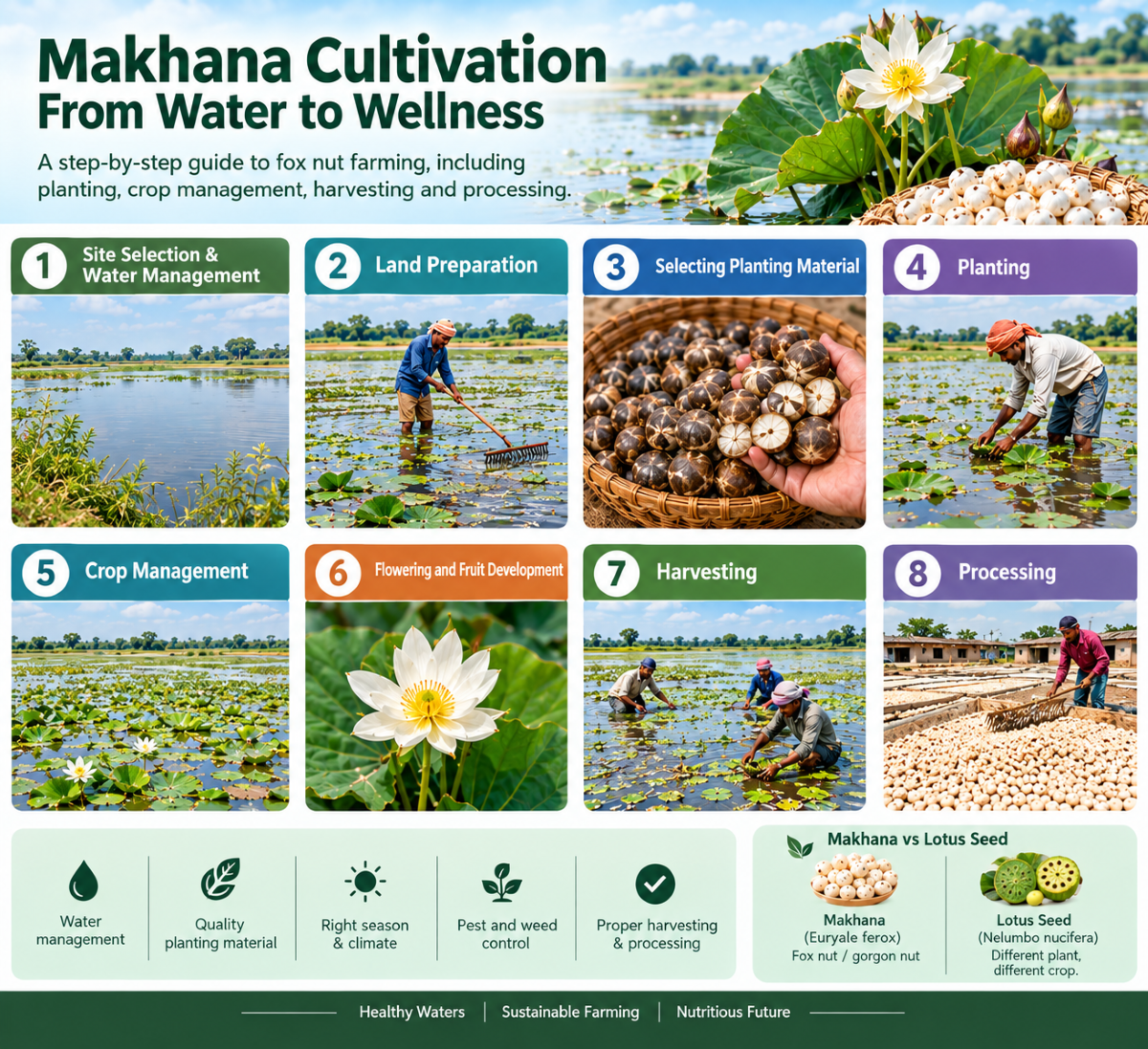
Makhana, also known as fox nut or gorgon nut, is the seed of the aquatic plant Euryale ferox. Makhana cultivation is an important aquatic farming activity in India, particularly in Bihar. Unlike many conventional crops, it can be cultivated in ponds, wetlands and suitable shallow-water fields.
India is the world's leading producer of makhana, while Bihar is the country's major production centre. According to the Government of India, Bihar accounted for nearly three-fourths of India's makhana production in 2025–26 and produced about 60,000 metric tonnes.
For farmers, successful fox nut farming depends on several factors, including the quality of planting material, water depth, transplanting time, crop management, harvesting skills and post-harvest handling.
Where Is Makhana Cultivated in India?
Makhana is mainly associated with the wetlands of eastern and northeastern India. Bihar is the dominant production state, with cultivation particularly concentrated in North Bihar.
Important growing areas include Purnea, Katihar, Madhubani, Darbhanga, Supaul, Saharsa, Madhepura, Araria, Kishanganj and Sitamarhi. ICAR has also reported cultivation in states such as Assam, West Bengal, Tripura, Odisha, Manipur and Madhya Pradesh.
These percentages are calculated from the district-wise APEDA data and represent the share of production among the 10 listed major makhana-producing districts
|
Rank |
Major district |
Makhana pop production (2021–22) |
Share of listed production |
|
1 |
Purnea |
5,234 tonnes |
22.1% |
|
2 |
Katihar |
4,858 tonnes |
20.5% |
|
3 |
Madhubani |
3,012 tonnes |
12.7% |
|
4 |
Darbhanga |
2,969 tonnes |
12.6% |
|
5 |
Supaul |
2,260 tonnes |
9.6% |
|
6 |
Saharsa |
2,167 tonnes |
9.2% |
|
7 |
Madhepura |
1,188 tonnes |
5.0% |
|
8 |
Araria |
1,056 tonnes |
4.5% |
|
9 |
Kishanganj |
800 tonnes |
3.4% |
|
10 |
Sitamarhi |
112 tonnes |
0.5% |
Makhana Cultivation Time and Suitable Conditions
The makhana cultivation time depends on the farming system and local climate. In the field-based cultivation system developed by ICAR, makhana can be transplanted around the second week of April and harvested around the second week of August. A water depth of about 30 cm is used in this system.
Traditionally, Makhana cultivation has relied on permanent, still water environments, such as ponds, wetlands, swamps and low-lying areas. Improved cultivation systems have also made it possible to grow makhana in shallow-water field conditions.
Steps of Makhana Cultivation in India
The exact method can varies depending to the pond, field conditions and planting material, the basic makhana cultivation process involves the following stages.
1. Managing Water Depth in Makhana Fields
Choose a pond, wetland or suitable low-lying field that can retain shallow water during the makhana crop period.
For field cultivation, proper water management is particularly important. In one ICAR-developed field cultivation system, approximately 30 cm of water depth is maintained; actual water requirements can vary with the cultivation system and local conditions.
2. Land and Field Preparation
Before makhana planting, remove excessive wild plants and unwanted vegetation. In pond-based farming, the water body should be prepared so that the young plants can establish without excessive competition.
Farmers should also consider drainage and water-retention conditions before starting the makhana crop.
3. Selecting Quality Planting Material
Quality planting material is one of the important factors affecting crop growth and productivity.
Improved varieties include Swarna Vaidehi, developed by ICAR's Research Complex for the Eastern Region, and Sabour Makhana-1, developed through Bihar Agricultural University. Swarna Vaidehi has reported a production potential of around 2.8–3.0 tonnes per hectare under farmer-field conditions.
4. Planting the Makhana Seedling
In the field-based method, seedlings are transplanted after suitable establishment. ICAR's cropping-system technology places transplantation around the second week of April.
Plant spacing and population should follow the recommendations for the selected variety and local cultivation system rather than using a single spacing rule for every pond or field.
5. Maintain Water and Crop Growth
Water depth needs regular monitoring. Too little water can affect crop growth, while unsuitable water conditions can create management problems.
During the growing period, farmers should monitor weeds, pests, diseases, water quality and plant density. Gap filling may be required where plant establishment is poor.
6. Monitoring Crop Health Until Seed Maturity
As the crop develops, flowers form and fruit matures. The mature fruits eventually release seeds into the water.
This stage requires careful observation because seed collection is an important part of traditional makhana farming.
Important Parameters to Keep in Mind During Makhana Cultivation
|
Parameter |
What Farmers Should Consider |
Important Pointer |
|
Season |
Mainly in the spring-to-monsoon crop cycle in Bihar |
Field-system transplantation is generally around April. |
|
Water depth |
Shallow water is suitable for field cultivation. |
The ICAR field method uses about 30 cm. |
|
Planting material |
Use quality seed/planting material. |
Consider improved varieties such as Swarna Vaidehi |
|
Growing area |
Pond, wetland or suitable shallow-water field |
Water retention and drainage matter |
|
Crop density |
Avoid excessive or insufficient plant population. |
Follow variety/system-specific recommendations. |
|
Weed management |
Prevent excessive competition. |
Regular observation is important. |
|
Water management |
Monitor depth and condition throughout the crop. |
Avoid unmanaged fluctuations. |
|
Harvesting |
Collect mature seeds carefully. |
Harvesting can be labour-intensive. |
|
Processing |
Cleaning, drying, grading, roasting and popping |
Post-harvest handling affects final quality. |
|
Major challenge |
Labour-intensive operations |
Mechanisation can reduce drudgery |
|
Market risk |
Prices can vary by quality and market. |
Grading and value addition can affect returns. |
How and When to Harvest Makhana
Harvesting makhana is different from harvesting many land-based crops. Mature seeds are collected from the water after the fruits release them.
Traditional makhana harvesting can involve workers entering the water and collecting seeds from the bottom. This makes the operation physically demanding and time-consuming. Studies and ICAR reports have highlighted harvesting and processing as major labour-intensive parts of the makhana value chain.
After collection, the raw seeds of makhana need to be cleaned and dried before they move into further processing.
Makhana Processing: Turning Raw Seeds into Popped Nuts
Raw makhana seed is not the same product as the white-popped makhana sold as a snack.
The makhana processing chain generally involves cleaning, grading, drying, roasting and popping. Traditional popping is a skilled operation.
According to ICAR, traditional processing involves roasting seeds at very high temperatures, tempering them and roasting them again before the seeds are manually popped. ICAR has also developed mechanised systems for threshing, cleaning, grading, drying, roasting and popping to reduce labour and improve working conditions. Therefore, farmers interested in commercial makhana should think beyond cultivation. Better post-harvest handling, grading, processing and market access can influence the final value of the crop.
Common Mistakes to Avoid
1. Using Poor-Quality Planting Material
Low-quality or unsuitable makhana planting material can result in poor crop growth and inconsistent production.
2. Ignoring Water Management
Makhana is an aquatic crop, but that does not mean you can ignore water management. Water depth and field conditions should be monitored throughout the life of the crop.
3. Planting Without Considering the Local Season
The correct makhana planting period changes with location and farming system. Farmers should follow local agricultural recommendations rather than copying a calendar from another region for makhana planting.
4. Crowding Your Crops
Planting crops too close together can create problems as they grow. Make sure there is enough space between plants so they can grow properly and are easier to manage.
5. Waiting Too Long to Harvest
Harvesting at the right time is important. Waiting too long to harvest can make seed collection harder and increase the risk of losses. Farmers should follow local maturity and harvesting.
6. Ignoring the Processing Stage
Harvesting is not the end of the process. Proper cleaning, drying, and processing are also important to maintain crop quality and prevent unnecessary losses.
7. Depending Completely on Traditional Methods
Traditional knowledge remains valuable, but farmers can also explore improved varieties, field-system cultivation and suitable mechanisation. ICAR has specifically worked on mechanising makhana popping to reduce worker drudgery
Challenges in Fox Nut Farming
Although fox nut farming has expanded, farmers still face several challenges. These include labour-intensive harvesting and processing, access to quality planting material, water-management problems, price fluctuations and limited access to modern processing facilities.
A recent Indian Journal of Extension Education study also identified regional differences in farming practices and highlighted socioeconomic and institutional factors affecting makhana cultivation in Bihar.
For commercial farmers, improving the complete chain—from planting material to cultivation, harvesting, processing and marketing—is therefore important.
Conclusion
Makhana cultivation has developed from a traditional wetland-based farming activity into an increasingly organised agricultural and food-processing sector. Bihar remains at the centre of India's makhana industry, with major production coming from districts such as Purnea, Katihar, Madhubani, Darbhanga, Supaul and Saharsa.
Successful cultivation requires suitable water conditions, quality planting material, timely transplantation, proper crop management and careful harvesting. However, the work does not end at harvesting. Makhana processing, grading, popping and marketing are equally important for maintaining quality and improving value.
Frequently Asked Questions About Makhana Cultivation
1. What is the best time for makhana cultivation?
The makhana cultivation schedule depends on the location and production system. In ICAR's field-based cultivation system, transplantation is carried out around the second week of April and harvesting around the second week of August.
2. Which seeds are used for makhana cultivation?
Farmers can use suitable quality planting material and improved varieties recommended for their region. Swarna Vaidehi is one improved variety developed by ICAR, while Sabour Makhana-1 has been developed by Bihar Agricultural University.
3. What are the major challenges in makhana cultivation?
Major challenges in makhana cultivation include labour-intensive harvesting and processing, water management, availability of quality planting material, market fluctuations and limited access to modern processing facilities.
4. Is makhana cultivation profitable?
Profitability depends on factors such as yield, cultivation cost, labour, water conditions, seed quality, processing costs and the price received by the farmer. Therefore, in makhana cultivation, profitability should be calculated using local costs and current market prices rather than assuming a fixed return.