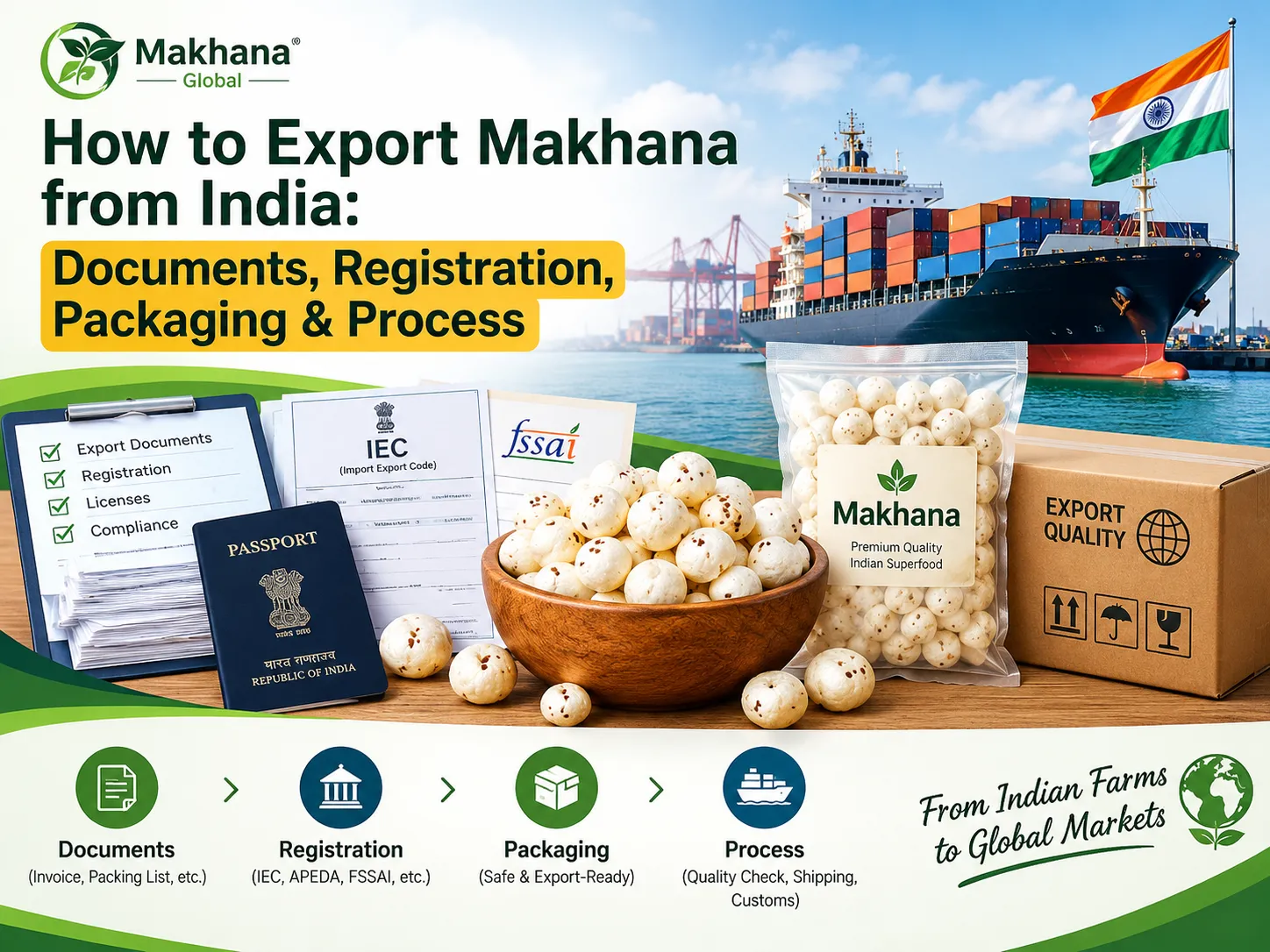
India is among the leading suppliers of makhana. The state of Bihar has a significant part in the production, processing and exporting of makhana. With the growing popularity of healthy snacks and plant-based foods in the international market, exporting makhana from India becomes an increasingly appealing activity for food business owners.
But if you are wondering how to export makhana from India, you will need much more than a buyer in the foreign country. Proper registrations, food safety regulations compliance, specification of the product, export documentation and packaging process will be required.
Why Indian Makhana Has Export Potential
Indian makhana is increasingly positioned as a premium snack and food ingredient. It can be sold internationally as plain popped makhana, roasted or flavoured snacks, makhana flour and other processed products.
The introduction of dedicated HS codes has also improved product classification. APEDA reports HS codes 20081921 for popped makhana, 20081922 for makhana flour and powder, and 20081929 for other makhana products.
Export opportunities can include:
-
Bulk B2B makhana
-
Retail-ready snack packs
-
Private-label products
-
Food manufacturers
-
Health-food distributors
-
Ethnic-food markets
The opportunity is promising, but quality consistency and regulatory compliance are essential for building repeat international orders.
Who Can Export Makhana from India
A manufacturer, processor, trader or merchant exporter can enter the makhana export business, provided the business meets applicable Indian regulations and the requirements of the destination country.
Before exporting, establish:
-
A legally registered business
-
PAN and appropriate banking arrangements
-
Import Export Code or IEC
-
Applicable FSSAI licence
-
Applicable APEDA registration or e-RCMC
-
Reliable makhana sourcing
-
Suitable processing and storage facilities
-
Export-capable packaging and logistics
DGFT states that an IEC is required for import/export activities unless specifically exempted.
Makhana Export Registration and Basic Requirements
IEC for Makhana Export
The Import Export Code (IEC) issued by DGFT is a core requirement for exporting goods from India. The application process is online through DGFT.
FSSAI Licence
Because makhana is a food product, exporters must comply with applicable FSSAI requirements. FSSAI states that food businesses require licensing/registration, and its export FAQ confirms that an FSSAI licence is required for food exporters; an additional FSSAI NOC is not required merely for exporting food.
APEDA and Applicable Registration
For APEDA scheduled products, exporters can apply for e-RCMC through the DGFT portal after obtaining IEC. Whether a particular makhana product requires APEDA registration should be confirmed according to its current classification and applicable rules.
Documents Required for Makhana Export
Correct documentation is essential because incomplete or inconsistent paperwork can delay customs clearance or payment.
Common makhana export documents include:
-
IEC
-
FSSAI licence
-
Applicable APEDA e-RCMC
-
Commercial invoice
-
Packing list
-
Shipping bill
-
Bill of lading or airway bill
-
Certificate of origin, where required
-
Certificate of analysis or laboratory report, where required
-
Insurance documents, where applicable
-
Destination-specific certificates or declarations
DGFT identifies the bill of lading/airway bill or applicable transport document, commercial invoice-cum-packing list and shipping bill/bill of export among the mandatory export documents, while additional documents may apply to specific products or regulatory conditions.
Makhana Quality Requirements for International Markets
International buyers generally want clearly defined specifications rather than simply "premium quality." Before accepting an order, agree on measurable product parameters.
Grade and Size
Specify the required makhana grade, size, appearance and acceptable broken percentage.
Product Specifications
Your specification sheet can include:
-
Product type
-
Grade/size
-
Colour and appearance
-
Broken percentage
-
Moisture specification
-
Shelf life
-
Packing format
-
Batch identification
Food Safety and Testing
Depending on the destination market and buyer, testing may be required for microbiological parameters, contaminants, pesticide residues or other food-safety criteria.
Traceability
Maintain supplier, batch, processing, testing and dispatch records. Good traceability makes quality complaints easier to investigate and supports long-term B2B relationships.
Makhana Export Packaging and Labelling Requirements
Makhana export packaging should protect the product from moisture, contamination, crushing and quality deterioration during storage and transportation.
Depending on the buyer and market, exporters may use:
-
Food-grade laminated pouches
-
Vacuum or modified-atmosphere packaging where appropriate
-
Bulk food-grade bags
-
Strong export cartons
-
Retail and private-label packs
The label should be prepared according to the importing country's applicable food-labelling rules. Do not assume that an Indian retail label automatically satisfies foreign-market requirements.
A professional export label may need information such as product name, net quantity, ingredients where applicable, batch/lot identification, dates, country of origin and importer information, subject to destination rules.
How to Find and Verify International Makhana Buyers
A successful makhana exporter should identify buyers according to the product and target market.
Potential buyer categories include:
-
Importers
-
Distributors
-
Food manufacturers
-
Private-label companies
-
Ethnic-food distributors
-
Health-food wholesalers
-
Snack brands
Before shipping a large order, verify the buyer's company identity, business address, website, purchasing requirements, payment terms and references where available.
Start with samples and clearly documented specifications instead of immediately committing to a large shipment.
Makhana Export Order Process from India
The practical export workflow can be structured as:
Buyer enquiry → Product specification → Sample approval → Quotation → Purchase order/contract → Quality testing → Production and packaging → Export documentation → Customs clearance → Shipment → Payment and record keeping
For first-time exporters, working with an experienced freight forwarder and customs broker can simplify shipping documentation and coordination.
Conclusion
Understanding how to export makhana from India requires a systematic approach. IEC, FSSAI compliance, applicable APEDA registration, correct HS classification, quality testing, export-grade packaging, documentation and buyer verification all play an important role.
Instead of focusing only on finding buyers, build a complete export system with consistent sourcing, measurable product specifications and reliable fulfilment. This can help Indian makhana exporters move from one-time shipments toward sustainable international B2B relationships.
Ready to start your makhana export business? Begin by selecting your target country, defining your makhana grade and packaging format, checking destination-specific regulations and preparing your export documentation before approaching international buyers.
FAQ
What is required to export makhana from India?
An exporter generally needs the applicable business registrations, IEC, FSSAI compliance, applicable APEDA/e-RCMC requirements, product documentation, compliant packaging and destination-specific export documents.
Is IEC mandatory for makhana export?
Yes. DGFT states that an IEC is required for import/export activities unless a specific exemption applies.
Is FSSAI required for a makhana exporter?
Yes. FSSAI confirms that a food exporter needs an FSSAI licence.
What is the HS code for popped makhana?
APEDA reports 20081921 for popped makhana. Makhana flour and powder is classified under 20081922, while other makhana products fall under 20081929 under the newer dedicated classification.
What packaging is suitable for makhana export?
Food-grade moisture-resistant packaging, appropriate inner packs and strong outer cartons can be used depending on whether the shipment is bulk, retail or private label. The final packaging must meet the importing country's requirements.
How can I find international makhana buyers?
Target importers, distributors, food manufacturers, private-label companies and ethnic-food distributors. Use verified business information and start with samples and clearly agreed specifications before accepting large orders.