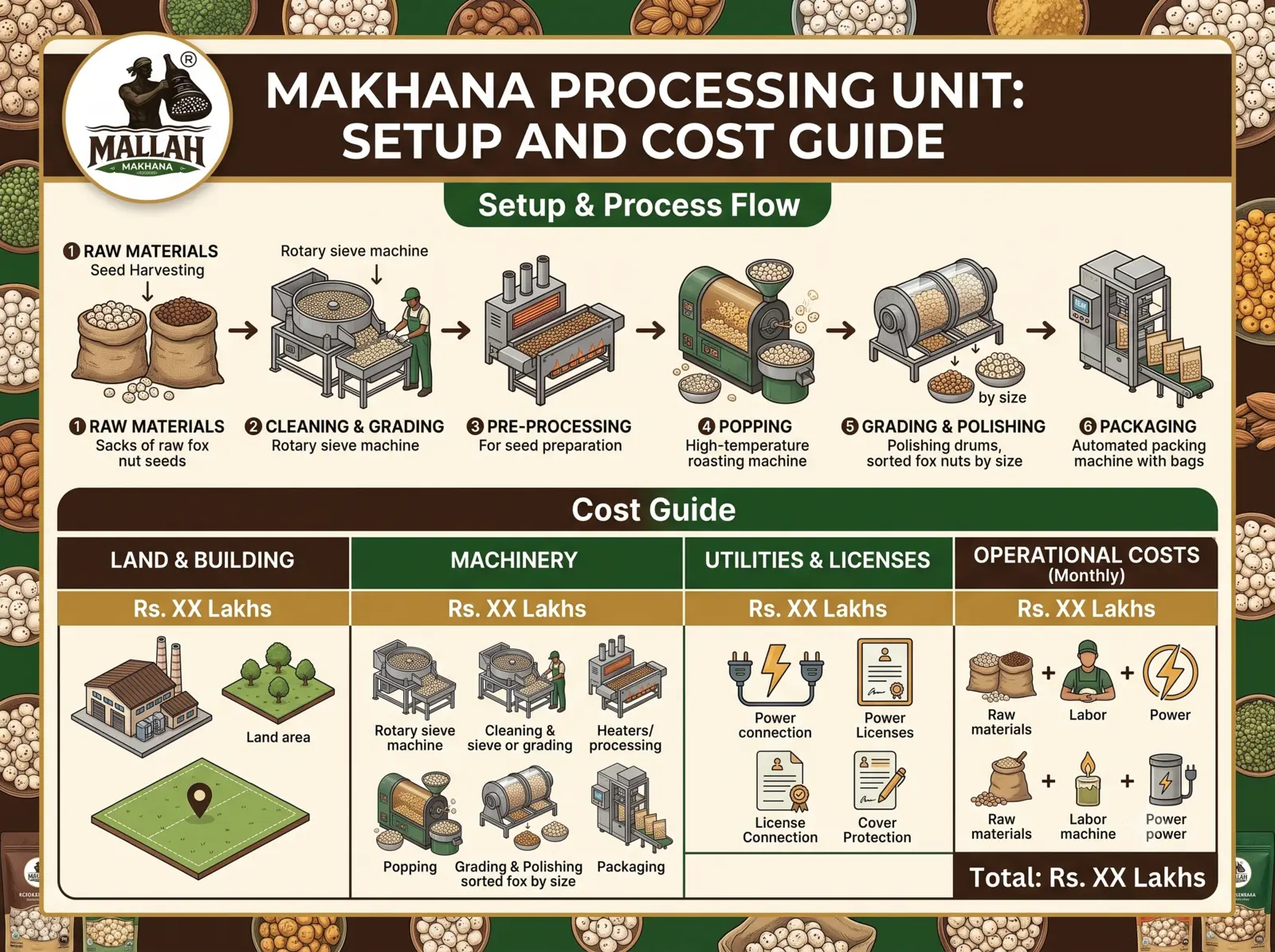
Makhana has become one of India’s most promising food-processing products, especially with growing demand for roasted, flavoured, premium and packaged makhana. If you are planning a makhana processing business, setting up the right facility and machinery is important for product quality, production efficiency and long-term profitability.
A makhana processing unit setup generally involves raw material procurement, cleaning, sorting, grading, processing, quality control, packaging and storage. The investment can vary significantly depending on production capacity, automation level, location, machinery selection and working capital requirements.
What Is a Makhana Processing Unit?
A makhana processing unit is a facility where raw or semi-processed makhana is cleaned, sorted, graded, processed and prepared for wholesale or retail sale. Depending on the business model, the unit may also include roasting, flavouring, private labelling and retail packaging.
A typical workflow includes:
-
Raw makhana procurement
-
Post-harvest handling
-
Cleaning and removal of impurities
-
Sorting and grading
-
Processing or roasting
-
Quality checking
-
Weighing and packaging
-
Finished-product storage
-
Value-added processing such as flavoured makhana
Makhana Processing Workflow
A well-planned processing flow helps reduce material handling and maintain hygiene.
Raw Material → Cleaning → Sorting → Grading → Processing → Quality Check → Weighing → Packaging → Storage → Dispatch
The exact workflow depends on whether you are processing raw makhana from the beginning or purchasing already popped makhana for grading, roasting and packaging.
Space Required for a Makhana Processing Unit
The required space depends on production capacity and automation. A small unit can operate from a comparatively compact facility, while a commercial makhana processing plant needs separate areas for production, storage and packaging.
Important areas include:
-
Raw material area: For receiving and storing incoming makhana
-
Processing area: For cleaning, sorting, grading and processing
-
Packaging area: For weighing, sealing and labelling
-
Finished goods storage: Clean, dry and protected from moisture
-
QC area: For quality inspection and batch checks
-
Movement space: Adequate room for workers and material handling
The premises should have proper ventilation, drainage, pest-control measures, washable surfaces and hygienic food-handling conditions.
Makhana Processing Machinery
Machinery selection should match your expected production volume rather than simply choosing the largest available machine.
Cleaning Equipment
A makhana cleaning machine can help remove dust, small particles and other unwanted material before further processing.
Sorting Equipment
Sorting equipment separates unsuitable or damaged pieces and can improve consistency in the final product.
Grading and Sieving Equipment
A makhana grading machine separates makhana according to size or grade. Consistent grading is particularly useful for premium retail products.
Processing Equipment
Depending on your product, processing machinery may include roasting, heating or flavouring equipment. Food-contact components should be suitable for food processing and easy to clean.
Weighing Equipment
Accurate weighing machines are essential for maintaining consistent pack sizes and controlling material costs.
Packaging Equipment
A makhana packaging machine can automate filling and sealing. Options may include pouch packing, vacuum packing or other formats depending on the product and market.
Makhana Processing Unit Cost
The makhana processing unit cost is not a single fixed amount. It depends on capacity, automation, premises and product range.
Major cost components include:
|
Cost Area |
What It Covers |
|
Premises |
Rent, deposit, construction or modification |
|
Machinery |
Cleaning, sorting, grading and processing equipment |
|
Electrical setup |
Wiring, panels, connections and installation |
|
Storage |
Racks, bins and storage infrastructure |
|
Packaging |
Pouches, labels, sealing and packing equipment |
|
Labour |
Operators, helpers, packaging staff and supervision |
|
Compliance |
Registrations, licences and documentation |
|
Working capital |
Raw material, wages, utilities and daily operations |
For this reason, prepare a project-specific cost estimate instead of relying on a generic machinery price.
How to Choose Makhana Processing Machinery
Before purchasing makhana processing machinery, compare suppliers on practical parameters.
Consider:
-
Production capacity per hour
-
Expected output and processing loss
-
Power consumption
-
Labour requirement
-
Machine dimensions
-
Cleaning and maintenance requirements
-
Spare-parts availability
-
Vendor installation and service support
-
Food-contact material suitability
-
Warranty and after-sales support
A lower machine price does not necessarily mean lower operating costs. Energy consumption, downtime, maintenance and labour can significantly affect the total cost of ownership.
Can Government Schemes Support a Makhana Processing Unit?
Food-processing entrepreneurs may find government schemes or institutional financing relevant to their project, depending on eligibility, location, business structure and the specific scheme available at the time of application.
Before applying, check the current requirements with the relevant government department, bank or implementing agency. Eligibility, subsidy structure, contribution requirements and eligible machinery can vary.
Should You Buy Machinery Before Applying for a Subsidy?
It is generally better to understand the scheme's eligibility and eligible expenditure before making major machinery purchases. Keep quotations, technical specifications, invoices and other required documents properly organised.
Do not assume that every machine or expenditure will automatically qualify for financial support.
Documents for Setting Up a Processing Unit
Common documents may include:
-
Business registration documents
-
FSSAI registration or licence, as applicable
-
GST registration, where applicable
-
Udyam registration
-
Premises ownership or rental documents
-
Machinery quotations
-
Project report
-
Bank and financial documents
-
Applicable local permissions
The exact documentation depends on the business structure, location, capacity and financing or scheme being used.
Common Machinery-Buying Mistakes
Avoid purchasing equipment based only on the quoted price. Common mistakes include:
-
Choosing machinery without calculating actual capacity
-
Ignoring power consumption
-
Not checking food-contact materials
-
Failing to confirm spare-parts availability
-
Buying excessive automation for a small operation
-
Not checking after-sales service
-
Ignoring installation and training costs
-
Not planning space around the machinery
A proper production plan should come before the machinery order.
FAQs About Makhana Processing Unit Setup
How much does a makhana processing unit cost?
The investment varies according to capacity, automation, premises, machinery, packaging requirements and working capital. A detailed project report provides a more realistic estimate than a fixed industry-wide figure.
Which machines are required for makhana processing?
Depending on the process, equipment can include cleaning, sorting, grading, processing, weighing and packaging machinery.
Is a makhana grading machine necessary?
It can be valuable when consistent size and grade are important for premium retail, wholesale or export-oriented products.
Can a small entrepreneur start a makhana processing business?
Yes, a small-scale operation can begin with selected processing and packaging activities and expand machinery and capacity as demand increases.
What should I check before buying machinery?
Check capacity, output, power consumption, food-contact suitability, maintenance, spare parts, warranty, installation and after-sales support.
Conclusion
A well-planned makhana processing unit setup can create opportunities across wholesale, retail, private-label and value-added makhana products. The key is to align your machinery, facility size, production capacity and working capital with your actual business plan.
If you are planning to start a makhana processing business, begin with a detailed feasibility study and machinery comparison before investing. Plan the unit first, choose machinery second, and scale production according to market demand.