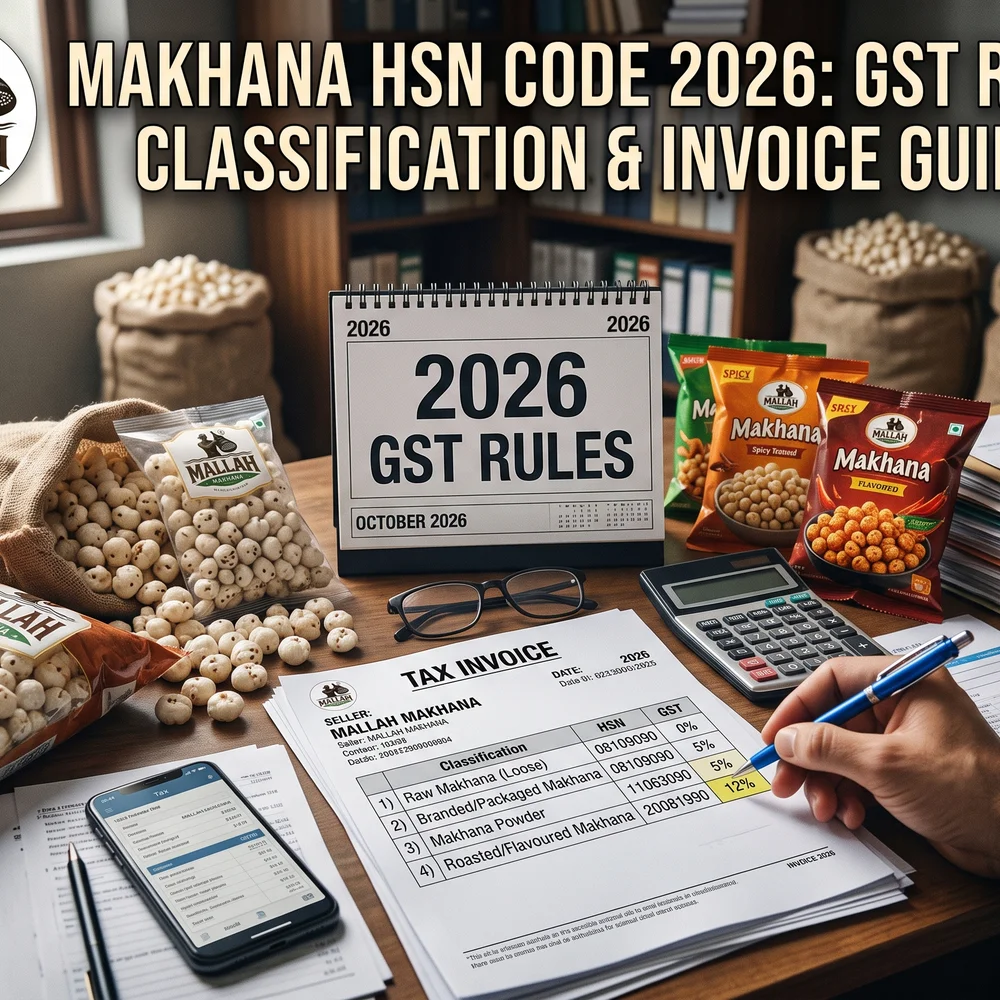
If you are a makhana trader, manufacturer, wholesaler, retailer, or exporter, using the correct Makhana HSN code is important for GST invoicing, accounting, and regulatory compliance. With dedicated tariff items now available for different makhana products, businesses have better clarity when preparing invoices and export documents.
The correct classification can also matter for GST rate determination, e-invoicing, e-way bill documentation, and export reporting. However, HSN classification and GST rate are not the same thing. The applicable tax treatment depends on the exact product, its processing, and the conditions prescribed under the relevant GST notification.
1. What is the HSN Code for Makhana?
Makhana now has specific 8-digit tariff classifications under heading 2008 for certain processed makhana products. The Indian Trade Portal lists dedicated codes for popped makhana, makhana flour or powder, and other makhana products.
|
Makhana Product |
HSN Code |
|
Popped Makhana |
20081921 |
|
Makhana Flour or Powder |
20081922 |
|
Other Makhana Products |
20081929 |
These dedicated codes were introduced to improve product identification and trade data, particularly for India's growing makhana export sector. APEDA has also highlighted the introduction of separate HSN codes for these categories.
Important: These codes should not be automatically applied to every makhana product. Raw or dried makhana and highly processed or formulated products may require different classification analysis.
2. What is the GST Rate on Makhana?
There is no safe one-line answer, such as “makhana has 5% GST.” The GST treatment depends on the product's classification and applicable conditions.
For dried makhana under heading 08, the CBIC GST rate schedule distinguishes between supplies that are pre-packaged and labelled and those that are not. The schedule specifies 5% GST for dried makhana when pre-packaged and labelled, while dried makhana other than pre-packaged and labelled is listed at a nil rate.
Therefore, businesses should consider:
-
Whether the product is dried, popped, or otherwise processed
-
The applicable HSN classification
-
Whether the product is prepackaged and labelled
-
Its ingredients and formulation
-
The GST notification applicable to the transaction date
Do not determine GST merely by copying the rate from another supplier's invoice.
3. Raw or Dried Makhana vs Popped Makhana
One of the most important distinctions is between dried/raw makhana and processed makhana.
Dried makhana has its own treatment under heading 08, while popped makhana is specifically identified under HSN 20081921. The Indian Trade Portal describes 20081921 specifically as popped makhana.
For businesses, the practical distinction looks like this:
-
Dried/raw makhana: Check the applicable heading 08 treatment and packaging conditions.
-
Popped makhana: HSN 20081921.
-
Roasted makhana: Classification should be examined according to the actual preparation and product composition.
-
Flavoured makhana: Do not automatically assume the same classification as plain popped makhana.
-
Makhana flour/powder: HSN 20081922.
-
Makhana-based formulated products: Classification may depend on ingredients, processing, and essential character.
This distinction is particularly important for manufacturers selling multiple SKUs.
4. HSN Code for Makhana on a GST Invoice
A GST invoice should identify the product clearly and include the appropriate HSN code and applicable tax details.
Illustrative invoice structure
Product: Popped Makhana
HSN: 20081921
Quantity: 100 kg
Rate: ₹XXX per kg
Tax: Applicable GST
Tax Amount: ₹XXX
Invoice Total: ₹XXX
This is only an example. The actual GST rate and tax calculation should be verified for the specific product and transaction.
For B2B sales, accurate HSN reporting helps maintain consistency between invoices, accounting records, and GST returns. Businesses should also ensure that their billing or ERP software uses the current tariff classification.
5. HSN Code for Exporting Makhana
The new dedicated makhana tariff items are particularly useful for exporters. DGFT's updated ITC HS classification lists 20081921 for popped makhana, 20081922 for makhana flour and powder, and 20081929 for other makhana, with these export policy entries shown as Free.
For exporters, the correct HSN can support:
-
Export documentation
-
Customs classification
-
Trade statistics
-
Commercial invoices
-
Shipping documentation
-
Product identification in international trade
If you are planning overseas sales, also check our guide on How to Export Makhana from India: Documents, Registration, Packaging & Process for a complete export workflow.
6. HSN Code for Different Makhana Products
|
Product |
Classification |
|
Dried Makhana |
Heading 08 treatment; GST depends on applicable conditions |
|
Popped Makhana |
20081921 |
|
Makhana Flour/Powder |
20081922 |
|
Other Makhana Products |
20081929 |
|
Roasted Makhana |
Classification depends on preparation |
|
Flavoured Makhana |
Classification depends on formulation and preparation |
The Indian Trade Portal separately identifies other makhana products under 20081929. It also lists additional subcategories under the broader 200819 heading, demonstrating why a product should be assessed based on its actual nature rather than its marketing name.
7. Common HSN and GST Mistakes
Makhana businesses can avoid many compliance problems by checking classification before creating invoices.
Common mistakes include:
-
Using one HSN for every makhana product
-
Copying a competitor's HSN without verification
-
Confusing HSN classification with GST rate
-
Ignoring pre-packaged and labelled conditions
-
Continuing to use an outdated HSN
-
Failing to update accounting software
-
Treating roasted and flavoured products exactly like plain popped makhana
-
Using an incorrect HSN on export documentation
Key takeaway
Identify the exact product first, determine the applicable HSN second, and then verify the GST rate and conditions.
Frequently Asked Questions
What is the HSN code for makhana?
The dedicated HSN codes include 20081921 for popped makhana, 20081922 for makhana flour and powder, and 20081929 for other makhana products.
What is the GST rate on makhana?
The rate depends on the product and applicable classification and conditions. For dried makhana under heading 08, CBIC distinguishes between pre-packaged and labelled supplies and other supplies.
What is the HSN code for popped makhana?
The HSN code for popped makhana is 20081921.
What is the HSN code for makhana flour?
Makhana flour and powder are classified under HSN 20081922.
Is GST applicable on raw makhana?
The answer depends on whether the product is classified as dried makhana and whether the applicable packaging and labelling conditions are met. CBIC lists dried makhana other than pre-packaged and labelled at Nil rate and pre-packaged and labelled dried makhana at 5%.
What is the HSN code for roasted makhana?
There is no basis for automatically assigning one code to every roasted makhana product. Classification should be checked against the actual preparation, ingredients and processing.
What HSN code should be used on a makhana invoice?
Use the HSN corresponding to the actual product being sold. For example, popped makhana is listed under 20081921, while makhana flour and powder are under 20081922.
What is the HSN code for exporting makhana?
For the dedicated export tariff classifications, 20081921, 20081922 and 20081929 cover popped, flour/powder and other makhana products respectively. DGFT lists these export-policy entries as Free.
Conclusion
The introduction of dedicated Makhana HSN codes is an important development for India's makhana industry. Businesses can now identify popped makhana, makhana flour or powder and other makhana products more precisely in domestic and international trade.
However, correct compliance requires more than simply knowing the HSN. Product form, processing, composition, packaging, labelling and the applicable GST notification all matter.
If you manufacture, wholesale or export makhana, review your product catalogue, invoices and accounting software to ensure the correct classification is being used. When the classification or GST treatment is uncertain, obtain confirmation from a qualified GST professional or the relevant tax authority before issuing the invoice.