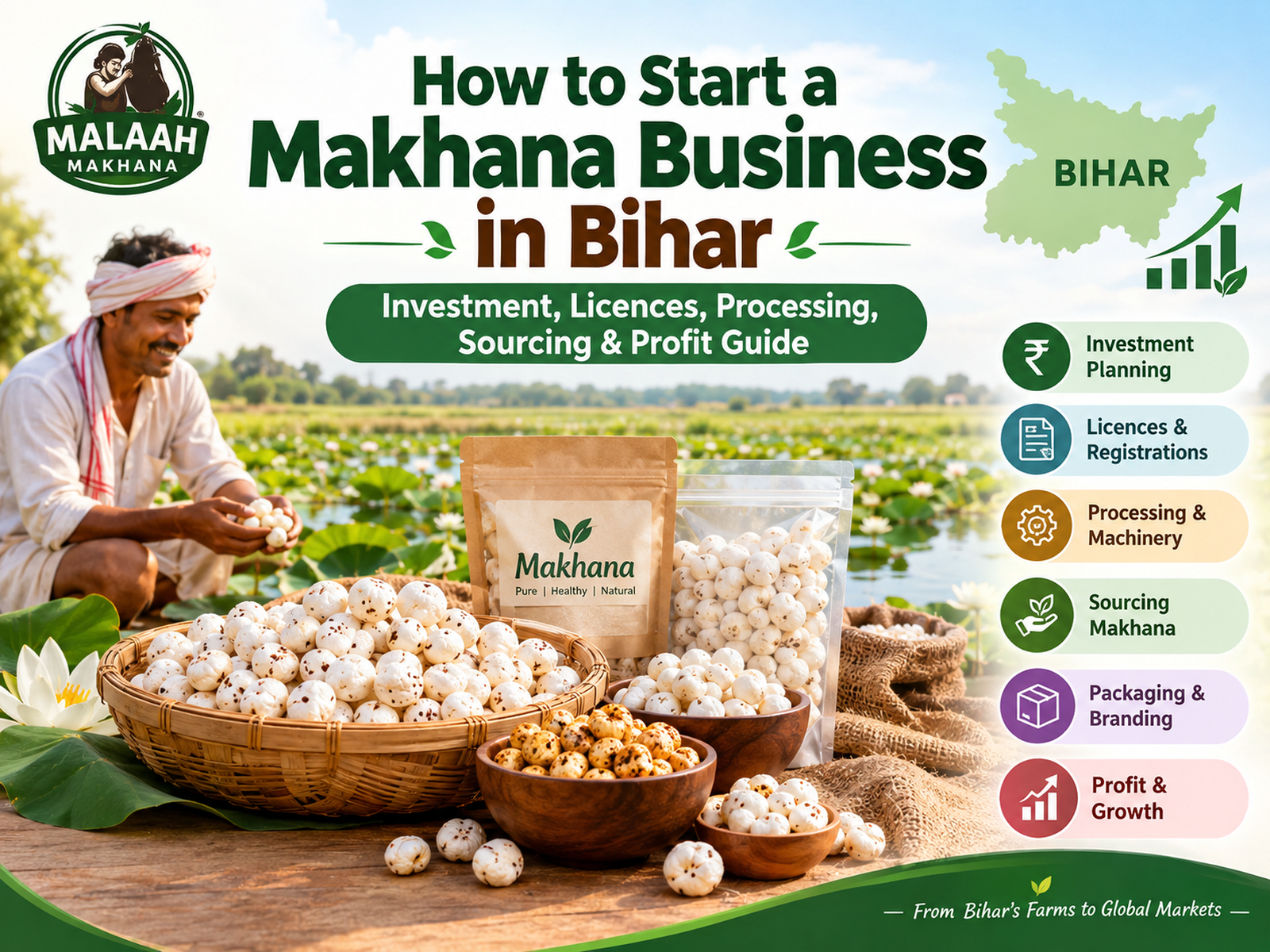
Makhana has become one of Bihar’s most recognised agricultural and food-processing products, creating opportunities not only for farmers but also for traders, processors, wholesalers, retailers and food brands. If you are researching how to start makhana business in Bihar, the biggest opportunity is not simply buying and selling fox nuts. The real business potential lies in building a reliable supply chain, maintaining consistent quality, adding value through processing and packaging, and developing dependable buyers.
Bihar has a strong ecosystem around makhana, and the Union Budget 2025-26 specifically announced a Makhana Board in Bihar to improve production, processing, value addition, marketing and the organisation of FPOs. This makes the sector particularly relevant for entrepreneurs considering a makhana startup, makhana processing business, wholesale operation or packaged-food brand.
However, starting a makhana business should not be approached as a quick-profit opportunity. Raw material prices, grades, working capital, processing losses, packaging costs, buyer demand and quality consistency can all affect margins.
This guide explains how to start a makhana business step by step, including business models, investment, registrations, sourcing, machinery, government schemes, packaging, marketing and common mistakes.
Is Makhana Business Profitable?
A makhana business in Bihar can be profitable, but profitability depends on the business model and how efficiently you manage procurement, grading, processing, inventory and sales. A trader buying and reselling raw or graded makhana operates very differently from a manufacturer selling branded roasted makhana to consumers.
For example, suppose an entrepreneur purchases makhana in bulk, sorts it into different grades, packs selected grades and sells them to retailers or institutional buyers. The business is not simply about the difference between purchase and selling price. The entrepreneur must account for sorting loss, labour, packaging, transportation, storage, wastage, credit given to buyers, taxes and marketing expenses.
Therefore, makhana business profit should always be calculated using contribution margin and actual operating costs rather than an assumed percentage.
Factors that influence makhana business profit
-
Raw makhana purchase price
-
Grade and size of makhana
-
Procurement volume
-
Sorting and grading losses
-
Processing yield
-
Labour expenses
-
Packaging cost
-
Storage and transportation
-
Wholesale versus retail selling price
-
Buyer payment cycle
-
Brand and marketing expenses
-
Product returns or quality complaints
-
Seasonal price fluctuations
Key takeaway: Before investing heavily, prepare a realistic makhana business plan based on actual supplier quotations and buyer enquiries.
Choose Your Makhana Business Model
One of the first decisions in learning how to start makhana business in Bihar is selecting the right business model. You do not necessarily need a large factory. A new entrepreneur can start with trading or wholesale distribution and gradually move into processing and branded products.
Makhana Trading
Trading is one of the simpler entry models. You purchase makhana from farmers, aggregators, processors or local suppliers and sell it to wholesalers, retailers or other businesses.
The main advantage is comparatively lower infrastructure requirements. However, trading margins can be sensitive to market prices, and working capital becomes important because inventory can consume significant funds.
A trader should develop relationships with multiple suppliers rather than depending on one source.
Wholesale Makhana Supply
A makhana wholesale business focuses on supplying larger quantities to retailers, snack companies, distributors, restaurants, food manufacturers and other commercial buyers.
Wholesale buyers usually care about:
-
Consistent grade
-
Size and appearance
-
Cleanliness
-
Moisture and storage conditions
-
Packaging format
-
Quantity availability
-
Delivery reliability
-
Pricing
-
Documentation and food-safety compliance
A wholesale operation can become stronger when it offers repeatable specifications instead of simply quoting the lowest price.
Processing & Grading
A makhana processing business adds value by sorting, grading, cleaning, roasting or otherwise preparing makhana according to the intended market.
This model requires more investment and operational control than simple trading. You need appropriate equipment, food-grade premises, trained workers, quality-control procedures and reliable procurement.
Processing can also create opportunities to sell different grades to different customer segments rather than treating all raw material as one product.
Packaged Makhana Brand
A packaged makhana brand can sell flavoured, roasted, plain or other value-added products through:
-
Local retailers
-
Supermarkets
-
Online marketplaces
-
Direct-to-consumer websites
-
Modern trade
-
Corporate gifting
-
Distributors
-
Health-food stores
This model can potentially provide greater control over the consumer-facing product, but it also requires investment in branding, packaging, marketing, distribution and customer acquisition.
Export Business
Exporting makhana introduces another level of opportunity, but it also brings additional documentation, buyer requirements, product specifications, logistics and destination-market compliance.
For businesses undertaking export/import activities, an Importer-Exporter Code (IEC) is generally required unless an applicable exemption applies. DGFT describes IEC as a mandatory code for import/export activities, subject to specified exemptions.
Do not start exporting simply because international selling prices appear attractive. First understand the destination country's food regulations, labelling requirements, buyer specifications, testing requirements, freight costs and payment terms.
How Much Investment Is Required?
There is no single fixed figure for makhana business investment because a trading operation and a processing-and-packaging unit have completely different capital requirements.
A small entrepreneur may begin with a limited inventory and basic storage arrangement, while a processing unit may require substantially more capital for premises, machinery, electrical infrastructure, packaging equipment, labour and working capital.
|
Cost Area |
What to Consider |
|
Raw Makhana |
Grade, quality, quantity and supplier terms |
|
Premises |
Rent/ownership, accessibility and food-safety suitability |
|
Machinery |
Capacity, automation, maintenance and electricity requirements |
|
Packaging |
Retail pouches, bulk bags, cartons and labelling |
|
Labour |
Sorting, processing, packing and supervision |
|
Compliance |
Food-business and business registrations applicable to your model |
|
Marketing |
Branding, website, sampling, distributors and advertising |
|
Working Capital |
Inventory, wages, packaging, logistics and buyer credit |
A practical investment approach
Instead of asking only, “How much money is required to start a makhana business?”, divide your available capital into three buckets:
1. Fixed investment: machinery, equipment, furniture and setup.
2. Operating investment: rent, electricity, labour, packaging, transportation and marketing.
3. Working capital: money required to purchase inventory and operate while waiting for customer payments.
For many food businesses, working capital is underestimated. An entrepreneur may spend heavily on machinery and then struggle to purchase enough raw material or fulfil large orders. A sensible makhana business plan therefore protects sufficient funds for day-to-day operations.
Registrations Required for a Makhana Business
The exact compliance requirements depend on whether you are trading, manufacturing, processing, storing, packing or exporting food products.
Company or Firm
Choose an appropriate business structure such as proprietorship, partnership, LLP or company based on ownership, investment, liability and growth plans.
GST
GST registration should be assessed according to the nature and scale of your business, applicable thresholds and transaction requirements. A tax professional can confirm the exact requirement for your business structure and turnover.
Udyam/MSME Registration
Udyam registration can be useful for eligible MSMEs. The official Udyam portal states that registration is free, paperless and based on self-declaration, with no renewal requirement.
The portal also reflects the revised MSME classification criteria applicable from April 2025.
FSSAI
Food businesses need to address applicable FSSAI registration or licensing requirements. FSSAI provides an online system through FoSCoS for food-business licensing and registration.
FSSAI guidance states that food business operators must obtain the appropriate licence or registration before starting applicable food-business activities.
The category of licence depends on the nature and scale of the food business, so do not automatically assume that every makhana business requires the same type of FSSAI approval.
Trademark
If you are launching a consumer-facing brand, consider trademark protection before investing heavily in packaging and marketing. IP India allows individuals, startups, SMEs, companies and other eligible entities to apply for trademarks.
IEC for Export
If your business plans to export makhana, obtain the applicable IEC from DGFT and complete other export-related requirements.
Important: Registrations should be determined based on your exact activities, turnover, location, product and sales channels. Consult the relevant authority or a qualified professional before commencing operations.
How to Source Makhana in Bihar
Procurement can determine whether your business succeeds or struggles. Instead of buying solely on price, establish a supplier evaluation system.
Potential sources include:
-
Farmers
-
FPOs
-
Aggregators
-
Processors
-
Wholesale suppliers
Bihar's growing institutional focus on the makhana value chain is also relevant. The announced Makhana Board is intended to support production, processing, value addition, marketing and FPO organisation.
What should you check before purchasing?
Ask suppliers about:
-
Grade and size
-
Sorting standards
-
Broken percentage
-
Cleanliness
-
Moisture/storage conditions
-
Available quantity
-
Batch consistency
-
Packaging
-
Delivery schedule
-
Payment terms
-
Replacement policy for quality issues
Before placing a large order, buy samples from multiple suppliers and compare them under the same conditions.
A useful practice is to maintain a supplier scorecard covering quality, price, consistency, delivery, communication and documentation.
Makhana Processing & Machinery
The machinery required depends on what your business actually does.
A trading business may require little more than suitable storage, weighing equipment and basic handling infrastructure. A processing operation may require equipment for cleaning, grading, sorting, roasting or packaging.
Possible equipment categories include:
-
Cleaning equipment
-
Sorting/grading equipment
-
Weighing scales
-
Roasting equipment, where applicable
-
Cooling arrangements
-
Sealing machines
-
Packaging machines
-
Batch coding equipment
-
Storage racks
-
Food-grade containers
-
Quality-testing equipment as appropriate
Do not buy machinery first
One of the most common mistakes in a makhana manufacturing business is purchasing machinery before understanding the required capacity.
First determine:
-
Expected monthly production.
-
Product mix.
-
Required grade separation.
-
Processing steps.
-
Packaging formats.
-
Number of shifts.
-
Electricity availability.
-
Labour requirement.
-
Expected buyer orders.
Then select equipment.
For a new entrepreneur, starting with a scalable setup may be more sensible than purchasing an oversized automated line that remains underutilised.
Government Schemes for Makhana Businesses
Entrepreneurs should investigate government support before finalising their financing structure. One relevant programme is the PM Formalisation of Micro Food Processing Enterprises (PMFME) scheme.
The official PMFME information states that eligible individual micro food-processing units can receive credit-linked capital subsidy of 35% of eligible project cost, subject to a maximum of ₹10 lakh per unit, with beneficiary contribution and bank-loan requirements specified under the scheme.
PMFME also supports common infrastructure and eligible groups, including FPOs, FPCs, cooperatives and SHGs, with support covering activities such as sorting, grading, storage, processing, packaging, marketing and testing infrastructure.
The PMFME portal currently provides information on applications, loans, ODOP and scheme features.
Do not build your business around subsidy
A subsidy can improve project economics, but it should not be the foundation of the business model.
Before applying, prepare:
-
Project report
-
Machinery quotations
-
Cost estimates
-
Working-capital calculation
-
Expected sales
-
Buyer details
-
Cash-flow projection
-
Promoter contribution
-
Loan repayment plan
Always verify current eligibility, scheme availability and applicable guidelines before making financial commitments.
Packaging & Branding
Packaging becomes especially important when you move from bulk trading to retail sales.
Your packaging should protect the product from moisture, contamination, physical damage and handling-related problems. The packaging material and food-contact suitability should comply with applicable food-safety requirements.
For retail products, the label should contain the declarations applicable to the product and business category under current FSSAI and legal-metrology requirements. FSSAI maintains current food regulations and notifications, so businesses should verify the latest requirements rather than relying on an old label template.
Good packaging should communicate
-
Brand name
-
Product name
-
Net quantity
-
Applicable FSSAI details
-
Ingredients, where applicable
-
Nutritional information, where applicable
-
Batch/lot information
-
Date-related declarations
-
MRP
-
Customer-care information
-
Storage instructions
-
Manufacturer/packer/marketer details, as applicable
Your branding should also make a clear distinction between plain makhana, roasted makhana and flavoured products.
How to Find Buyers for Your Makhana Business
A good procurement network is only half the business. You also need a predictable sales pipeline.
Potential buyers include:
-
Local grocery stores
-
Dry-fruit retailers
-
Supermarkets
-
Distributors
-
Snack manufacturers
-
Restaurants
-
Institutional buyers
-
Online sellers
-
Private-label brands
-
Export buyers
Start by creating a simple buyer database. Record the buyer's location, product requirement, monthly quantity, preferred grade, packaging requirement, expected price, payment cycle and feedback.
For a new makhana startup, B2B sampling can be more informative than immediately spending heavily on advertising. Send representative samples, obtain feedback and refine the product specification before scaling.
How to Build a Makhana Business Plan
A practical makhana business plan should answer six questions:
1. What will you sell?
Raw makhana, graded makhana, roasted products, flavoured snacks, private-label products or export packs?
2. Who will buy it?
Wholesalers, retailers, brands, distributors, consumers or overseas buyers?
3. Where will you source it?
Farmers, FPOs, aggregators, processors or wholesale suppliers?
4. How will you process it?
Will you only sort and pack, or will you roast, flavour and manufacture finished products?
5. What will it cost?
Calculate raw material, processing loss, labour, packaging, transport, rent, utilities, compliance, marketing, interest and working capital.
6. How will you make money?
Calculate the contribution per kilogram or per pack, then estimate monthly sales volume and fixed expenses.
A simple formula is:
Gross contribution = Selling price − Direct product cost
Then:
Operating profit = Gross contribution − Fixed operating expenses
This is more useful than simply saying that makhana is a “high-margin” product.
Common Mistakes When Starting a Makhana Business
Buying machinery without planning
Equipment should match your production volume and product specification.
Ignoring working capital
Large inventory purchases can lock up cash. Always calculate the cash conversion cycle.
Choosing inconsistent grades
Different batches should meet the specifications promised to buyers.
No quality-control process
Create documented checks for incoming material, processing, packing and finished goods.
Depending entirely on subsidy
Government support can help, but the business should remain commercially viable without assuming that every proposed benefit will be approved.
Weak packaging
Poor packaging can reduce shelf appeal and potentially affect product quality during storage and transport.
No buyer research
Do not purchase large quantities merely because a supplier offers an attractive rate. First identify who will buy the finished product.
A Step-by-Step Roadmap to Start a Makhana Business in Bihar
If you want a straightforward action plan, follow this sequence:
Step 1: Select your business model.
Step 2: Research local suppliers and buyers.
Step 3: Collect samples and compare grades.
Step 4: Prepare a detailed makhana business plan.
Step 5: Calculate fixed investment and working capital.
Step 6: Select your business structure.
Step 7: Complete applicable registrations and food-safety compliance.
Step 8: Finalise premises and storage arrangements.
Step 9: Purchase only the machinery required for your planned capacity.
Step 10: Establish quality-control and procurement procedures.
Step 11: Test packaging and labelling.
Step 12: Begin with controlled sales to selected buyers.
Step 13: Track actual margins and customer feedback.
Step 14: Scale inventory, processing capacity and distribution only after validating demand.
Key Takeaways
-
Bihar provides a strong ecosystem for a makhana business.
-
You can start with trading, wholesale, processing, branded products or exports.
-
Your business model should determine your investment rather than the other way around.
-
Working capital is as important as machinery.
-
Supplier quality and grade consistency directly affect customer satisfaction.
-
Food businesses need to address applicable FSSAI requirements.
-
Udyam registration is available through the official MSME portal and is free and paperless.
-
PMFME may provide eligible financial and training support under its applicable guidelines.
-
Export businesses should understand IEC and destination-market requirements.
-
Packaging should protect the product while meeting applicable regulatory requirements.
-
Do not purchase machinery or large inventory before validating demand.
-
A sustainable makhana business profit comes from procurement discipline, quality, efficient operations and repeat customers.
Frequently Asked Questions About Starting a Makhana Business in Bihar
Is makhana business profitable in Bihar?
It can be profitable, but there is no guaranteed profit margin. Results depend on procurement price, product grade, processing yield, selling price, operating expenses, working capital and buyer demand.
How much investment is needed to start a makhana business?
Investment varies considerably. A small trading operation can require much less capital than a processing and branded manufacturing unit. Prepare separate estimates for inventory, machinery, premises, packaging, labour, compliance, marketing and working capital.
What is the best makhana business model for beginners?
There is no single model suitable for everyone. Entrepreneurs with limited infrastructure may consider trading or wholesale supply, while those with technical, financial and market capabilities may explore processing or branded products.
Is FSSAI required for a makhana business?
Food-business operators need to obtain the applicable FSSAI registration or licence before carrying out regulated food-business activities. The exact requirement depends on the nature and scale of the operation.
Can I get a government subsidy for a makhana processing business?
Eligible food-processing enterprises may be able to access support under schemes such as PMFME. The official scheme information specifies a credit-linked capital subsidy of 35% of eligible project cost, with a maximum of ₹10 lakh per eligible individual micro food-processing unit under the stated framework. Eligibility and current implementation conditions should be verified before applying.
Can I start a makhana business without a factory?
Yes. A business model based on trading or wholesale supply may not require a full manufacturing facility. However, your premises, storage, food handling and other compliance obligations must match the activities you actually undertake.
Is Udyam registration useful for a makhana startup?
Udyam registration can formally identify an eligible enterprise as an MSME. The official portal states that the registration process is free, online and paperless.
Do I need IEC to export makhana?
Generally, an IEC is required for import/export activities unless a specific exemption applies. DGFT provides the applicable IEC framework and online application process.
Conclusion
If you are exploring how to start makhana business in Bihar, think beyond simply purchasing fox nuts and selling them at a higher price. The strongest foundation is a well-researched business model supported by dependable sourcing, consistent grading, food-safe handling, appropriate processing, compliant packaging, disciplined working capital management and a clearly defined customer base.
Bihar's growing focus on makhana production, processing, value addition and marketing provides an important ecosystem for entrepreneurs. The announced Makhana Board is intended to strengthen these parts of the value chain, while programmes such as PMFME can provide support to eligible food-processing enterprises under their applicable guidelines.
Whether you start with a makhana wholesale business, build a makhana processing business, launch a retail brand or eventually enter exports, start with market validation rather than large expenditure. Talk to suppliers, collect samples, approach buyers, calculate your real landed cost and prepare a practical financial plan before investing.
If you are planning to enter the makhana industry, start by understanding your product, your buyer and your numbers. A carefully planned makhana startup can then scale step by step from local trading to processing, branding, wholesale distribution and potentially export markets.